The Boy on the Wooden Box
Bibliographic Information
Leyson, L. (2013). The boy on the wooden box. New York: Atheneum Books for Young Readers.
Summary
This is the memoir of Leon Leyson, one among many on Schindler's list. He begins telling his story by describing what his life in Poland was like before World War II began. He lived with his his mother and siblings in a small village in the country, while his father was in Krakow, working in a factory and saving money so his family could join him. After five years, Leon's father had enough saved, and they all finally moved to Krakow. Everyone was excited because they felt like this was a new start for their family, a chance for new experiences and better opportunities.
For a short time, things were looking up, but then the Leyson's started hearing rumors of another war. Not long after, the German army rolled in and occupied Poland. Leon and his family immediately felt the effects of the occupation. They were suddenly barred from many public places like the park, the trolley, and stores, and his father lost his job at the factory. As times grew worse, they had to sell off belongings just to have food to eat. Even though things were bad, the Leyson family had no idea just how horrifying they would get. The family was moved from their apartment into the Jewish ghetto, where they were forced to share a one-room apartment with another family. They lived in fear of being arrested and sent to work camps.
One lucky day, Mr. Leyson was called to open a safe for a prominent Nazi, and he so impressed the man that he was hired to work at the man's factory. That man was Oskar Schindler. Over the next few years, Leon's father's job offered the family some protection from the Nazis, but when it became all too clear that his job with Schindler couldn't protect them forever, Mr. Leyson began asking Schindler to hire the rest of his family. After months went by, months in which Leon was moved to a work camp and separated from his parents and siblings, months that Leon didn't think he would survive, he finally received word that he would now be working in Oskar Schindler's factory. Leon Leyson and his family worked for Schindler until the war ended. A few years after World War II ended, he moved to America with his mother and father. Leon married and had children and worked as a teacher for many years. He didn't often speak of what he went through in WWII, not until a reporter convinced him to share his story years and years later, when the film, 'Schindler's List,' was being released.
Impressions
Words can't describe the depth of feeling this book evokes. Like many historical fiction novels set during WWII, this book relates a story that seems too horrific to be true. Sadly, this book is true because Leon Leyson lived it. The characters' sheer strength and will-to-live is inspiring, but at the same time you question how they managed it as you read about the conditions they lived through. I would recommend this book to anyone upper elementary and older because it shows the impact that just one person can have on the world.
Review
This powerful memoir of one of the youngest boys on Schindler's list deserves to be shared. Leon Leyson grew up in Poland as the youngest of five children. As WWII breaks out, Leyson's ingenuity and bravery, combined with the kindness of strangers and a bit of serendipity, save his life, time and again. The storytelling can at times meander, and the various reflections of his life in Poland during the war can result in a certain patchiness, but Leyson's experiences and memories still make for compelling reading about what it was like to suffer through the Holocaust. This memoir is a natural curriculum addition to WWII units for upper-elementary and middle school readers. Be sure to have additional materials on hand about Oskar Schindler, as readers will want to do more research into Leyson's story.
Review Reference
Thompson, S. B. (2013, September 1). [Review of The Boy on the Wooden Box:
How the Impossible became Possible... on Schindler's List: a memoir, by L.
Leyson]. Booklist. Retrieved from http://libproxy.library.unt.edu:2114/
ehost/pdfviewer/pdfviewer?sid=07e07b66-002e-4d0e-b4d0-5111560bd9ba
%40sessionmgr4004&vid=18&hid=4103
Library Use
~ I think this book would be a great companion to a historical fiction novel set during WWII. Students could compare the HF text to this memoir and discuss similarities and differences in the two genres.
~ This book would be a wonderful addition to a WWII display.
Wednesday, April 29, 2015
Sunday, April 26, 2015
Module 10 Historical Fiction: Amelia and Eleanor go for a Ride
Amelia and Eleanor Go For a Ride
Bibliographic Information
Ryan, P. M. (1999). Amelia and Eleanor go for a ride. New York: Scholastic Press.
Summary
This is the story of the unique friendship between Amelia Earhart and Eleanor Roosevelt. Both women were independent, adventurous spirits ahead of their time. One evening Amelia and her husband are invited to join Eleanor at the White House for dinner. Over dinner the two friends begin talking about flying, and Eleanor asks what it is like to fly at night. Amelia immediately offers to leave dinner and take Eleanor on a ride over Washington, and off they go. They fly for a while, enjoying the wonder of the city lights far below. The story fittingly ends with the women headed off another adventure, this time with Eleanor at the wheel of her new car, driving off into the dark night with Amelia by her side.
Impressions
I found this book to be inspiring and full of a sense of adventure. I think it accurately presents the two main characters as strong women who weren't afraid to think for themselves and act in a way that wasn't the norm for the time. With that being said, it is a thoroughly enjoyable picture book in its own right, telling a tale of two friends having fun together. The black and white sketches are a perfect match with the text and add to the sense of wonder and excitement on each page. The double-page spread of Washington, D.C. lit up at night is breathtaking. The author's note at the end provides readers with interesting facts about the two women and the real events that inspired the story.
Review
Ryan imaginatively expands on a true historical event in this intriguing picture book. While dining at the White House in 1933, Amelia Earhart convinces Eleanor Roosevelt to join her on a night flight to Baltimore. The two women marvel at the sights and the excitement from the air. After landing, they sneak away for one more adventure, as this time, the First Lady treats her friend to a fast ride in her new car. The fictionalized tale is lively and compelling, and the courage and sense of adventure that these individuals shared will be evident even to children who know nothing about their lives. Without belaboring the message, the author clearly conveys how the "feeling of independence" that both women treasured was a crucial part of their personalities. Selznick's larger-than-life pencil drawings add considerably to the spirit of the tale. He captures the glorious beauty of the night flight and the beauty of the city below. Varied perspectives and background details consistently draw readers' eyes. An author's note clearly defines which elements of the story are factual. The women were actually accompanied by two I male pilots, but the author decided that it made it "much more exciting" to imagine that they were alone. "Almost all" of the dialogue comes from historical accounts. The title stands well on its own, but will also work as an excellent inspiration for further reading about the lives of Eleanor Roosevelt and Amelia Earhart.
Review Reference
Engelfried, S. (1999, September). [Review of Amelia and Eleanor Go for a Ride,
by P. M. Ryan]. School Library Journal. Retrieved from
http://libproxy.library.unt.edu:2114/ehost/detail/detail?vid=8sid=d18ee997-
be0b-470d-8aaa-db3c4efe6697%40sessionmgr4003&hid=4205&bdata=
JnNjb3BlPXNpdGU%3d#db=lls&AN=2265141
Library Use
~ This book would be great when studying famous women in history.
~ It could also be used to teach the historical fiction genre.
~ The illustrations could also be the focus of a lesson, discussing how the black and white pictures compliment and lend voice to the story.
Bibliographic Information
Ryan, P. M. (1999). Amelia and Eleanor go for a ride. New York: Scholastic Press.
Summary
This is the story of the unique friendship between Amelia Earhart and Eleanor Roosevelt. Both women were independent, adventurous spirits ahead of their time. One evening Amelia and her husband are invited to join Eleanor at the White House for dinner. Over dinner the two friends begin talking about flying, and Eleanor asks what it is like to fly at night. Amelia immediately offers to leave dinner and take Eleanor on a ride over Washington, and off they go. They fly for a while, enjoying the wonder of the city lights far below. The story fittingly ends with the women headed off another adventure, this time with Eleanor at the wheel of her new car, driving off into the dark night with Amelia by her side.
Impressions
I found this book to be inspiring and full of a sense of adventure. I think it accurately presents the two main characters as strong women who weren't afraid to think for themselves and act in a way that wasn't the norm for the time. With that being said, it is a thoroughly enjoyable picture book in its own right, telling a tale of two friends having fun together. The black and white sketches are a perfect match with the text and add to the sense of wonder and excitement on each page. The double-page spread of Washington, D.C. lit up at night is breathtaking. The author's note at the end provides readers with interesting facts about the two women and the real events that inspired the story.
Review
Ryan imaginatively expands on a true historical event in this intriguing picture book. While dining at the White House in 1933, Amelia Earhart convinces Eleanor Roosevelt to join her on a night flight to Baltimore. The two women marvel at the sights and the excitement from the air. After landing, they sneak away for one more adventure, as this time, the First Lady treats her friend to a fast ride in her new car. The fictionalized tale is lively and compelling, and the courage and sense of adventure that these individuals shared will be evident even to children who know nothing about their lives. Without belaboring the message, the author clearly conveys how the "feeling of independence" that both women treasured was a crucial part of their personalities. Selznick's larger-than-life pencil drawings add considerably to the spirit of the tale. He captures the glorious beauty of the night flight and the beauty of the city below. Varied perspectives and background details consistently draw readers' eyes. An author's note clearly defines which elements of the story are factual. The women were actually accompanied by two I male pilots, but the author decided that it made it "much more exciting" to imagine that they were alone. "Almost all" of the dialogue comes from historical accounts. The title stands well on its own, but will also work as an excellent inspiration for further reading about the lives of Eleanor Roosevelt and Amelia Earhart.
Review Reference
Engelfried, S. (1999, September). [Review of Amelia and Eleanor Go for a Ride,
by P. M. Ryan]. School Library Journal. Retrieved from
http://libproxy.library.unt.edu:2114/ehost/detail/detail?vid=8sid=d18ee997-
be0b-470d-8aaa-db3c4efe6697%40sessionmgr4003&hid=4205&bdata=
JnNjb3BlPXNpdGU%3d#db=lls&AN=2265141
Library Use
~ This book would be great when studying famous women in history.
~ It could also be used to teach the historical fiction genre.
~ The illustrations could also be the focus of a lesson, discussing how the black and white pictures compliment and lend voice to the story.
Wednesday, April 15, 2015
Module 9 Mystery: The Night my Sister Went Missing
The Night My Sister Went Missing
Bibliographic Information
Plum-Ucci, C. (2006). The night my sister went missing. Orlando: Harcourt, Inc.
Summary
What begins as a typical night on the beach for Kurt and his group of teenage friends, turns into a nightmare. One minute they're all hanging out on the old pier, talking and having fun, but the next someone starts passing around a small handgun that was brought to the party. Suddenly a shot- or was it a firework?- is heard, and Kurt's sister, disappears over the edge of the pier into the rough surf. Kurt spends the rest of his night hanging out at the police station, waiting on his parents to get back in town, and eavesdropping on all the locals who stop by to give their testimony.
At first it seems pretty clear that their friend Stacy had something to do with the tragedy. Some people think she pulled the trigger in a fit of jealousy, others think the gun going off was an accident, but almost everyone agrees that the gun belongs to Stacy. As Kurt listens, he learns things about his friends that he hadn't seen before. With his eyes wide open, Kurt begins to gain understanding about the difference between the public persona of his friends and the struggles that some of them were hiding. He also starts to realize that what he wants out of life may not match the plans he's made with his parents. Now if only his sister, Casey, is found and she's okay, Kurt is ready to make some honest decisions about his life. Will all of his friends be able to do the same?
Impressions
This is a good little mystery with a lot of character development mixed in. The reader has a unique perspective through Kurt listening to his friends' testimony. We see his reactions to all the revelations at the police station, and we watch him change and grow as he starts to understand how little he really knew his 'friends.' It is very interesting to see how all these events work together to help Kurt grow up, seemingly overnight. Of course, as more and more clues come to light, the story keeps readers intrigued with twists and turns that seem unrelated at first. I think that middle and high school students will enjoy this book because it is a mystery that will keep you guessing and invested in the story right up to the end.
Review
A shot rings out at a beach party. A girl falls backward- or dives forward- into the water and disappears. Her older brother, Kurt, remains in the police station all night anxious for word and spying on those who come to give their statements. The thread running through the speculations and accusations is Stacy Kearny, a poor little rich girl, whose explosive family secrets make her a prime suspect in the shooting. Plum-Ucci returns to a familiar topic- a young missing person and the questions raised by the disappearance- to explore class prejudice, teen cruelty, and loyalty between friends. There's no doubt Plum-Ucci can tell a heck of a story. But there are chink's in the narrative's armor: characters tend to sound the same, and the one-way mirror in the station that enables Kurt to spy on the witnesses sticks out like the device that it is. Still, readers will be turning pages as new information is dispensed in each chapter, moving and changing the story in unexpected ways. They'll race to the ending and won't guess it until they get there.
Review Reference
Cooper, I. (2006, October 15). [Review of The Night My Sister Went Missing, by
C. Plum-Ucci]. Booklist. Retrieved from http://libproxy.library.unt.edu:2114/
ehost/pdfviewer/pdfviewer?sid=fd78c378-e7ac-4026a5e0-beda838a3479%
40sessionmgr4003&vid=23&hid=4113
Library Use
~ This would be a great book to read and discuss, focusing on how the events affect the characters in different ways and how those characters change throughout the story.
~ It could also be used in a Mystery display or in a lesson about the various elements found in mysteries
Bibliographic Information
Plum-Ucci, C. (2006). The night my sister went missing. Orlando: Harcourt, Inc.
Summary
What begins as a typical night on the beach for Kurt and his group of teenage friends, turns into a nightmare. One minute they're all hanging out on the old pier, talking and having fun, but the next someone starts passing around a small handgun that was brought to the party. Suddenly a shot- or was it a firework?- is heard, and Kurt's sister, disappears over the edge of the pier into the rough surf. Kurt spends the rest of his night hanging out at the police station, waiting on his parents to get back in town, and eavesdropping on all the locals who stop by to give their testimony.
At first it seems pretty clear that their friend Stacy had something to do with the tragedy. Some people think she pulled the trigger in a fit of jealousy, others think the gun going off was an accident, but almost everyone agrees that the gun belongs to Stacy. As Kurt listens, he learns things about his friends that he hadn't seen before. With his eyes wide open, Kurt begins to gain understanding about the difference between the public persona of his friends and the struggles that some of them were hiding. He also starts to realize that what he wants out of life may not match the plans he's made with his parents. Now if only his sister, Casey, is found and she's okay, Kurt is ready to make some honest decisions about his life. Will all of his friends be able to do the same?
Impressions
This is a good little mystery with a lot of character development mixed in. The reader has a unique perspective through Kurt listening to his friends' testimony. We see his reactions to all the revelations at the police station, and we watch him change and grow as he starts to understand how little he really knew his 'friends.' It is very interesting to see how all these events work together to help Kurt grow up, seemingly overnight. Of course, as more and more clues come to light, the story keeps readers intrigued with twists and turns that seem unrelated at first. I think that middle and high school students will enjoy this book because it is a mystery that will keep you guessing and invested in the story right up to the end.
Review
A shot rings out at a beach party. A girl falls backward- or dives forward- into the water and disappears. Her older brother, Kurt, remains in the police station all night anxious for word and spying on those who come to give their statements. The thread running through the speculations and accusations is Stacy Kearny, a poor little rich girl, whose explosive family secrets make her a prime suspect in the shooting. Plum-Ucci returns to a familiar topic- a young missing person and the questions raised by the disappearance- to explore class prejudice, teen cruelty, and loyalty between friends. There's no doubt Plum-Ucci can tell a heck of a story. But there are chink's in the narrative's armor: characters tend to sound the same, and the one-way mirror in the station that enables Kurt to spy on the witnesses sticks out like the device that it is. Still, readers will be turning pages as new information is dispensed in each chapter, moving and changing the story in unexpected ways. They'll race to the ending and won't guess it until they get there.
Review Reference
Cooper, I. (2006, October 15). [Review of The Night My Sister Went Missing, by
C. Plum-Ucci]. Booklist. Retrieved from http://libproxy.library.unt.edu:2114/
ehost/pdfviewer/pdfviewer?sid=fd78c378-e7ac-4026a5e0-beda838a3479%
40sessionmgr4003&vid=23&hid=4113
Library Use
~ This would be a great book to read and discuss, focusing on how the events affect the characters in different ways and how those characters change throughout the story.
~ It could also be used in a Mystery display or in a lesson about the various elements found in mysteries
Tuesday, March 31, 2015
Module 8 Fantasy & Science Fiction: The Doll People
The Doll People
Bibliographic Information
Martin, A. M. & Godwin L. (2000). The doll people. New York: Hyperion Books for Children.
Summary
Annabelle and the rest of the Doll family live in an antique dollhouse in eight-year-old Kate's room. When Kate and the rest of her family aren't around, Annabelle's family come to life, moving and talking just like real people. They pass their days in the dollhouse, trying to avoid Kate's little sister, Nora, and the family cat. Annabelle, however, longs for some adventure outside the dollhouse, but her parents warn her to stay put so that she doesn't disappear like her long-lost Aunt Sarah.
The Funcrafts arrive on the scene on Nora's birthday. They are a new plastic doll family with their own modern, plastic dollhouse. It has amenity's that Annabelle and the rest of the Doll family have never heard of- a barbeque grill, microwave, and even a computer. The Doll family is not only perplexed by the Funcrafts' house but also by their attitudes. They seem to live for fun and adventure and ignore the "Doll Code of Honor." Annabelle, drawn by her adventurous nature, begins a friendship with Tiffany Funcraft.
Tiffany encourages Annabelle to follow her instincts and leave the dollhouse to search for Aunt Sarah. Using clues from Aunt Sarah's journal, the two girls travel all the way downstairs, hoping to find her. Along the way they run into trouble a few times, but they finally succeed in rescuing Aunt Sarah and returning her to the rest of the Doll family.
Impressions
This book is a very enjoyable story with enough elements of both adventure and humor that it will entertain many types of readers. The plot is appealing- the idea of dolls and other toys coming to life has been used successfully in several books and movies because it is such an intriguing thought to children. I think the addition of the Funcraft family adds a fun side-story to the disappearance of Aunt Sarah, and the humorous antics caused by Nora and the family cat give it a light-hearted feel. The illustrations are a great addition to the story. They help the reader visualize the many differences between the Doll and Funcraft families. This is a good introduction to the fantasy genre.
Review
A lighthearted touch and a dash of drama make this a satisfying read. When Annabelle Doll finds her Aunt Sarah's journal, she hopes it offers a clue to the whereabouts of her aunt, who has been missing for 45 years. Annabelle is forever eight years old-the same age as Kate, the current owner of the Victorian dollhouse in which she and her family have lived for the past century. Their new neighbors, the all-plastic Funcrafts, who arrive for Kate's younger sister's birthday, are modern and brashly confident. Their pink plastic house has a barbecue, a computer, and a VCR. Tiffany, the Funcraft doll-girl, is just the right age to be a first real friend for Annabelle, and her daring spirit inspires the child's quest for her aunt. Determined and brave, she persuades her cautious parents to let her venture out of the dollhouse in search of her relative. Along with the usual perils of moving about in the real world, there is the risk of being seen by a human and succumbing to "doll state" or even worse, "permanent doll state." Selznick's illustrations are perfectly suited to the innocent charm of the dolls and do much to draw readers into their world. The delightful endpapers, which resemble pages from toy catalogs past and present, tell their own tale about the characters. A light and uncomplicated fantasy/adventure in the tradition of Rumer Godden's doll stories or even Pam Conrad's The Tub People (HarperCollins, 1989).
Review Reference
Meizner, K. (2000, November). [Review of The Doll People, by A. M. Martin & L.
Godwin]. School Library Journal. Retrieved from http://libproxy.library.
unt.edu:2114/ehost/detail/detail?sid=31d5a8e5-6884-481d-
8d89-9ddeb948641f%40sessionmgr4001&vid=28&hid=4113&bdata=
JnNjb3BlPXNpdGU%3d#db=lls&AN=3746985
Library Use
~ I think this book would be a good tool to introduce the Fantasy genre to second or third graders. It would be a good read aloud over several visits to the library because it is lighthearted, funny, and doesn't have content that might be considered questionable.
Bibliographic Information
Martin, A. M. & Godwin L. (2000). The doll people. New York: Hyperion Books for Children.
Summary
Annabelle and the rest of the Doll family live in an antique dollhouse in eight-year-old Kate's room. When Kate and the rest of her family aren't around, Annabelle's family come to life, moving and talking just like real people. They pass their days in the dollhouse, trying to avoid Kate's little sister, Nora, and the family cat. Annabelle, however, longs for some adventure outside the dollhouse, but her parents warn her to stay put so that she doesn't disappear like her long-lost Aunt Sarah.
The Funcrafts arrive on the scene on Nora's birthday. They are a new plastic doll family with their own modern, plastic dollhouse. It has amenity's that Annabelle and the rest of the Doll family have never heard of- a barbeque grill, microwave, and even a computer. The Doll family is not only perplexed by the Funcrafts' house but also by their attitudes. They seem to live for fun and adventure and ignore the "Doll Code of Honor." Annabelle, drawn by her adventurous nature, begins a friendship with Tiffany Funcraft.
Tiffany encourages Annabelle to follow her instincts and leave the dollhouse to search for Aunt Sarah. Using clues from Aunt Sarah's journal, the two girls travel all the way downstairs, hoping to find her. Along the way they run into trouble a few times, but they finally succeed in rescuing Aunt Sarah and returning her to the rest of the Doll family.
Impressions
This book is a very enjoyable story with enough elements of both adventure and humor that it will entertain many types of readers. The plot is appealing- the idea of dolls and other toys coming to life has been used successfully in several books and movies because it is such an intriguing thought to children. I think the addition of the Funcraft family adds a fun side-story to the disappearance of Aunt Sarah, and the humorous antics caused by Nora and the family cat give it a light-hearted feel. The illustrations are a great addition to the story. They help the reader visualize the many differences between the Doll and Funcraft families. This is a good introduction to the fantasy genre.
Review
A lighthearted touch and a dash of drama make this a satisfying read. When Annabelle Doll finds her Aunt Sarah's journal, she hopes it offers a clue to the whereabouts of her aunt, who has been missing for 45 years. Annabelle is forever eight years old-the same age as Kate, the current owner of the Victorian dollhouse in which she and her family have lived for the past century. Their new neighbors, the all-plastic Funcrafts, who arrive for Kate's younger sister's birthday, are modern and brashly confident. Their pink plastic house has a barbecue, a computer, and a VCR. Tiffany, the Funcraft doll-girl, is just the right age to be a first real friend for Annabelle, and her daring spirit inspires the child's quest for her aunt. Determined and brave, she persuades her cautious parents to let her venture out of the dollhouse in search of her relative. Along with the usual perils of moving about in the real world, there is the risk of being seen by a human and succumbing to "doll state" or even worse, "permanent doll state." Selznick's illustrations are perfectly suited to the innocent charm of the dolls and do much to draw readers into their world. The delightful endpapers, which resemble pages from toy catalogs past and present, tell their own tale about the characters. A light and uncomplicated fantasy/adventure in the tradition of Rumer Godden's doll stories or even Pam Conrad's The Tub People (HarperCollins, 1989).
Review Reference
Meizner, K. (2000, November). [Review of The Doll People, by A. M. Martin & L.
Godwin]. School Library Journal. Retrieved from http://libproxy.library.
unt.edu:2114/ehost/detail/detail?sid=31d5a8e5-6884-481d-
8d89-9ddeb948641f%40sessionmgr4001&vid=28&hid=4113&bdata=
JnNjb3BlPXNpdGU%3d#db=lls&AN=3746985
Library Use
~ I think this book would be a good tool to introduce the Fantasy genre to second or third graders. It would be a good read aloud over several visits to the library because it is lighthearted, funny, and doesn't have content that might be considered questionable.
Sunday, March 29, 2015
Module 7 Realistic Fiction: Stargirl and Wonder
Stargirl
Bibliographic Information
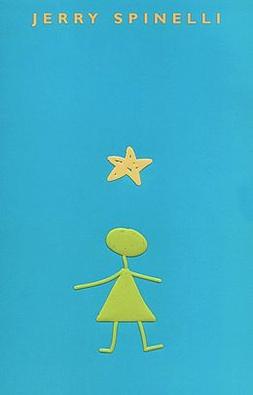
Spinelli, J. (2000). Stargirl. New York: Alfred A. Knopf.
Summary
This book is the story of Leo, a high school student in Arizona, and Susan, aka Stargirl. When Stargirl enrolls at Leo's high school, he and most of the other students think the way she dresses is odd, to say the least. She wears long skirts, flowy shirts, uses a big bag hand-painted with sunflowers, and carries a ukulele. Her behavior is also very unlike the other students'. She sings "Happy Birthday" to other kids at lunch, cheers for both her school and the opposing team at ballgames, and attends funerals of people she doesn't know. However different Stargirl's clothing and actions are, Leo can't help but be drawn to her. He is intrigued by the fact that she doesn't seem to have any concern about other people's opinion of her, unlike all the other high school kids he knows.
As time goes by Stargirl gains popularity because of her 'strange' behavior. The other students seem to applaud the fact that she's different and can't wait to see just what Stargirl will do next. During this time Leo allows himself get to know Stargirl, and he finds that he enjoys her company. As they begin a relationship of sorts, Leo knows that he really likes her but wonders if he's strong enough to be with someone who is just so different.
Just as one would expect, Stargirl's popularity is short-lived. Students become upset with her for doing the very thing that they were applauding a few months before. The basketball team, for the first time, is having a winning season. Stargirl, who is now a part of the cheerleading squad, has continued her routine of cheering for both their high school and the team they are playing against. As the team moves to the playoffs for the first time, students begin to resent Stargirl for cheering for the other team. They believe that she should put all of her efforts toward cheering their team onto the championship game. Leo convinces Stargirl to try to fit in- to dress and act more like everyone else. Of course, in the end this doesn't change the other students' opinion of Stargirl. All it does is make her feel unhappy. Even though Leo knows he should be a bigger person and ignore all the negative feelings toward Stargirl, he just can't. He misses his friends and doesn't like being ignored by everyone. Leo and Stagirl break up, and the story ends with Stargirl and her family moving away. Leo is left to wonder where she is and if she's still out there doing random acts of kindness.
Impressions
Stargirl is a brilliant character, one that exemplifies the self-confidence and understanding of self that we hope all humans develop during their lives. She has no desire to conform to the expectations of others and finds joy in doing small things to make others' lives a little better. Putting such a character in the middle of already developed high school friendships and cliques is a recipe for drama. Seeing the action through Leo's eyes, a boy who is admittedly shy and wants to keep out of the spotlight, gives the reader an honest lens through which to view Stargirl. Leo has enough self-awareness that he realizes how special Stargirl is but also knows that he lacks the strength to stand by her. I think this is a very important point in the story because this will be the factor that many readers connect with. Reading about the struggle that Leo goes through will hopefully help them when they are in a similar situation, which they undoubtedly will be sometime during their school years. Readers can empathize with Leo's choices, while at the same time, feel his regret at not being able to ignore the popular kids and follow his heart.
Review
High school is a time of great conformity, when being just like everybody else is of paramount importance. So it is no surprise that Stargirl Caraway causes such excitement and confusion when she arrives at Mica High in Arizona. Initially, everyone is charmed by her unconventional behavior--she wears unusual clothing, she serenades the lunchroom with her ukulele, she practices random acts of kindness, she is cheerleader extraordinaire in a place with no school spirit. Naturally, this cannot last and eventually her individuality is reviled. The story is told by Leo, who falls in love with Stargirl's zany originality, but who then finds himself unable to let go of the need to be conventional. Spinelli's use of a narrator allows readers the distance necessary to appreciate Stargirl's eccentricity and Leo's need to belong to the group, without removing them from the immediacy of the story. That makes the ending alt the more disappointing-to discover that Leo is looking back imposes an unnecessary adult perspective on what happened in high school. The prose lapses into occasionally unfortunate flowery flights, but this will not bother those readers-girls especially-who will understand how it feels to not quite fit the mold and who attempt to exult in their differences.
Bibliographic Information
Palacio, R. J. (200 ). Wonder. New York: Alfred A. Knopf.
Summary
Wonder is the story of August, or Auggie as he's known to his family and friends. August was born with a very rare birth defect that caused his face to be deformed. At the beginning of the book August tells the reader that he doesn't want to describe what he looks like because he looks worse than whatever we could imagine.
The story follows August through his fifth grade year, which is also his first year of going to school. He was previously home-schooled by his mom because of health issues, including the many surgeries he has undergone. As expected, Auggie faces his share of obstacles throughout the year. Kids whisper as he walks through the halls and sometimes go one step further and ask him rude questions or say mean things about his appearance. Luckily August finds friendship with Summer and Jack. Even though his new friendships have some rocky points, and a boy named Julian works hard to ruin August's school year, he manages to work through the challenges and find a way to fit in.
The story is told from multiple points of view. August, his sister Olivia, friends Summer and Jack, and other characters tell their own version of the story throughout the book. This gives the reader insight into how August's condition has affected not only him but the people around him.
Impressions
This book is a wonderful story that tugs at the heartstrings but gives a very accurate representation of the joys and perils of life in middle school. While August does encounter some negative people that try to make his first experience in school less than enjoyable, he also develops some great friendships. Any student that reads the book will find at least one character that brings forth connections with their own life. While most of us didn't have such huge obstacles to overcome during our time in middle school, we all faced moments of feeling like we didn't belong. Anyone who reads Wonder will have a better understanding of how to react when they come into contact with people who are seen as different or not part of the 'in-crowd.'
Review
Due to a rare genetic disorder, Auggie Pullman's head is malformed, his facial features are misshapen, and he has scars from corrective surgery. After much discussion and waffling, he and his parents decide it's time for him to go to a regular school for the fifth grade instead of being homeschooled. All his life Auggie has seen the shocked expressions and heard the whispers his appearance generates, and he has his coping strategies. He knows that except for how he looks, he's a normal kid. What he experiences is typical middle school--the good and the bad. Meanwhile, his beautiful sister is starting high school and having her own problems. She's finding that friendships change and, though it makes her feel guilty, she likes not being labeled as Auggie's sister. Multiple people tell this story, including Auggie, two of his new school friends, his sister, and his sister's former best friend. Palacio has an exceptional knack for writing realistic conversation and describing the thoughts and emotions of the characters. Everyone grows and develops as the story progresses, especially the middle school students. This is a fast read and would be a great discussion starter about love, support, and judging people on their appearance. A well-written, thought-provoking book.
Review Reference
Reeder, Nancy P. (2012, February). [Review of Wonder, by R. J. Palacio]. School
Library Journal. Retrieved from http://libproxy.library.unt.edu:2071/ehost/
detail/detail?vid=32&sid=68e8dce1-ecf7-42d2-a3f1-d53a933fe6b4%
40sessionmgr110&hid=104&bdata=JnNjb3BlPXNpdGU%3d#db=a9h&AN=
71418101
Library Use
~ This would be a great book to teach point of view and how individual characters' perspectives affect how the events in the story are relayed to the reader.
Bibliographic Information
Spinelli, J. (2000). Stargirl. New York: Alfred A. Knopf.
Summary
This book is the story of Leo, a high school student in Arizona, and Susan, aka Stargirl. When Stargirl enrolls at Leo's high school, he and most of the other students think the way she dresses is odd, to say the least. She wears long skirts, flowy shirts, uses a big bag hand-painted with sunflowers, and carries a ukulele. Her behavior is also very unlike the other students'. She sings "Happy Birthday" to other kids at lunch, cheers for both her school and the opposing team at ballgames, and attends funerals of people she doesn't know. However different Stargirl's clothing and actions are, Leo can't help but be drawn to her. He is intrigued by the fact that she doesn't seem to have any concern about other people's opinion of her, unlike all the other high school kids he knows.
As time goes by Stargirl gains popularity because of her 'strange' behavior. The other students seem to applaud the fact that she's different and can't wait to see just what Stargirl will do next. During this time Leo allows himself get to know Stargirl, and he finds that he enjoys her company. As they begin a relationship of sorts, Leo knows that he really likes her but wonders if he's strong enough to be with someone who is just so different.
Just as one would expect, Stargirl's popularity is short-lived. Students become upset with her for doing the very thing that they were applauding a few months before. The basketball team, for the first time, is having a winning season. Stargirl, who is now a part of the cheerleading squad, has continued her routine of cheering for both their high school and the team they are playing against. As the team moves to the playoffs for the first time, students begin to resent Stargirl for cheering for the other team. They believe that she should put all of her efforts toward cheering their team onto the championship game. Leo convinces Stargirl to try to fit in- to dress and act more like everyone else. Of course, in the end this doesn't change the other students' opinion of Stargirl. All it does is make her feel unhappy. Even though Leo knows he should be a bigger person and ignore all the negative feelings toward Stargirl, he just can't. He misses his friends and doesn't like being ignored by everyone. Leo and Stagirl break up, and the story ends with Stargirl and her family moving away. Leo is left to wonder where she is and if she's still out there doing random acts of kindness.
Impressions
Stargirl is a brilliant character, one that exemplifies the self-confidence and understanding of self that we hope all humans develop during their lives. She has no desire to conform to the expectations of others and finds joy in doing small things to make others' lives a little better. Putting such a character in the middle of already developed high school friendships and cliques is a recipe for drama. Seeing the action through Leo's eyes, a boy who is admittedly shy and wants to keep out of the spotlight, gives the reader an honest lens through which to view Stargirl. Leo has enough self-awareness that he realizes how special Stargirl is but also knows that he lacks the strength to stand by her. I think this is a very important point in the story because this will be the factor that many readers connect with. Reading about the struggle that Leo goes through will hopefully help them when they are in a similar situation, which they undoubtedly will be sometime during their school years. Readers can empathize with Leo's choices, while at the same time, feel his regret at not being able to ignore the popular kids and follow his heart.
Review
High school is a time of great conformity, when being just like everybody else is of paramount importance. So it is no surprise that Stargirl Caraway causes such excitement and confusion when she arrives at Mica High in Arizona. Initially, everyone is charmed by her unconventional behavior--she wears unusual clothing, she serenades the lunchroom with her ukulele, she practices random acts of kindness, she is cheerleader extraordinaire in a place with no school spirit. Naturally, this cannot last and eventually her individuality is reviled. The story is told by Leo, who falls in love with Stargirl's zany originality, but who then finds himself unable to let go of the need to be conventional. Spinelli's use of a narrator allows readers the distance necessary to appreciate Stargirl's eccentricity and Leo's need to belong to the group, without removing them from the immediacy of the story. That makes the ending alt the more disappointing-to discover that Leo is looking back imposes an unnecessary adult perspective on what happened in high school. The prose lapses into occasionally unfortunate flowery flights, but this will not bother those readers-girls especially-who will understand how it feels to not quite fit the mold and who attempt to exult in their differences.
Review Reference
Grover, S. (2000, August). [Review of Stargirl, by J. Spinelli]. School Library
Journal. Retrieved from http://libproxy.library.unt.edu:2114/ehost/detail/
detail?vid=8&sid=07319936-9264-44d1-8f32-17d2946c7d3e%
40sessionmgr4005&hid=4205&bdata=JnNjb3BlPXNpdGU%3d#db=
lls&AN=3454911
Library Use
Library Use
~ Stargirl could be used to promote the realistic fiction genre. Since is is told through the eyes of a boy, I believe this is a good book to tempt boys to try the genre if they don't typically read realistic fiction.
WonderBibliographic Information
Palacio, R. J. (200 ). Wonder. New York: Alfred A. Knopf.
Summary
Wonder is the story of August, or Auggie as he's known to his family and friends. August was born with a very rare birth defect that caused his face to be deformed. At the beginning of the book August tells the reader that he doesn't want to describe what he looks like because he looks worse than whatever we could imagine.
The story follows August through his fifth grade year, which is also his first year of going to school. He was previously home-schooled by his mom because of health issues, including the many surgeries he has undergone. As expected, Auggie faces his share of obstacles throughout the year. Kids whisper as he walks through the halls and sometimes go one step further and ask him rude questions or say mean things about his appearance. Luckily August finds friendship with Summer and Jack. Even though his new friendships have some rocky points, and a boy named Julian works hard to ruin August's school year, he manages to work through the challenges and find a way to fit in.
The story is told from multiple points of view. August, his sister Olivia, friends Summer and Jack, and other characters tell their own version of the story throughout the book. This gives the reader insight into how August's condition has affected not only him but the people around him.
Impressions
This book is a wonderful story that tugs at the heartstrings but gives a very accurate representation of the joys and perils of life in middle school. While August does encounter some negative people that try to make his first experience in school less than enjoyable, he also develops some great friendships. Any student that reads the book will find at least one character that brings forth connections with their own life. While most of us didn't have such huge obstacles to overcome during our time in middle school, we all faced moments of feeling like we didn't belong. Anyone who reads Wonder will have a better understanding of how to react when they come into contact with people who are seen as different or not part of the 'in-crowd.'
Review
Due to a rare genetic disorder, Auggie Pullman's head is malformed, his facial features are misshapen, and he has scars from corrective surgery. After much discussion and waffling, he and his parents decide it's time for him to go to a regular school for the fifth grade instead of being homeschooled. All his life Auggie has seen the shocked expressions and heard the whispers his appearance generates, and he has his coping strategies. He knows that except for how he looks, he's a normal kid. What he experiences is typical middle school--the good and the bad. Meanwhile, his beautiful sister is starting high school and having her own problems. She's finding that friendships change and, though it makes her feel guilty, she likes not being labeled as Auggie's sister. Multiple people tell this story, including Auggie, two of his new school friends, his sister, and his sister's former best friend. Palacio has an exceptional knack for writing realistic conversation and describing the thoughts and emotions of the characters. Everyone grows and develops as the story progresses, especially the middle school students. This is a fast read and would be a great discussion starter about love, support, and judging people on their appearance. A well-written, thought-provoking book.
Review Reference
Reeder, Nancy P. (2012, February). [Review of Wonder, by R. J. Palacio]. School
Library Journal. Retrieved from http://libproxy.library.unt.edu:2071/ehost/
detail/detail?vid=32&sid=68e8dce1-ecf7-42d2-a3f1-d53a933fe6b4%
40sessionmgr110&hid=104&bdata=JnNjb3BlPXNpdGU%3d#db=a9h&AN=
71418101
Library Use
~ This would be a great book to teach point of view and how individual characters' perspectives affect how the events in the story are relayed to the reader.
Tuesday, March 17, 2015
Module 6 Picture Books: Not a Box
Bibliographic Information
Portis, A. (2006). Not a box. New York: Harper Collins Publishers.
Summary
A little rabbit uses his imagination to create a world of fun with a simple cardboard box. He pretends he is driving a race car, putting out fires, and flying in a hot air balloon. An unseen narrator keeps asking questions such as, "Why are you sitting in that box?" The rabbit repeats, "It's not a box," so many times that he finally imagines himself blasting off in a rocket.
Impressions
This book is adorable! The entertaining and playful dialogue between the narrator and the rabbit along with the simple line drawings will delight young children. They will enjoy the rabbit's creative uses of the box as well as the repetitive, humorous nature of the text. I love the book cover, which looks like a cardboard box itself. This book is a perfect read aloud to engage kids and spark their imagination.
Review
This is the book that began [Portis'] career and now we’ve many a fine title from her since. I’m pleased to note that this is one I once reviewed. This Geisel Honor winner (not too shabby) made equal use of simple words and a clean simple format to ensure that Ms. Portis burst out upon the scene. As debuts go, this one was hard to beat.
The description from my review is: As the story opens and the reader flips through the publication and title page, a small bunny spots and tugs away a box that it has found. Now we see the bunny sitting quietly within his treasure as someone (perhaps the reader) asks, “Why are you sitting in a box?” A turn of the page and it’s the same bunny in the same box, but now red lines have appeared around them to sketch out a fabulous racing car. The opposite page is now bright red and at the bottom of it sit the words, “It’s not a box.” Turn the page and now the bunny is standing on top of the box. When asked why, the red lines have turned the box into an alpine peak with the bunny at the crest of the summit. “It’s not a box.” And so it goes until the reader finally asks of the bunny (with, perhaps, a note of impatience in the question), “Well, what is it then?” The bunny ponders this, in the same position as Rodin’s, “The Thinker”, then comes up with a fabulous answer. As we see it blasting off into space it waves good-bye from its rocket-box to say, “It’s my Not-a-Box!” The last image is of a distant bunny soaring past the planet Saturn.
Part of the allure lies with the packaging. The book is bound without a dust jacket, the brown cardboard of the book serving as its actual cover. It’s smart formatting (very box-like) but the real question is this: How well does it stand up to use in a public library? My copies, which are moderately used, remain intact if slightly fuzzy after multiple small sticky hands have played with them. However you can still make out the title on the spine (more than can be said for my copies of A Series of Unfortunate Events) so we’ll declare this an unqualified design success.
Kirkus said of it, “Portis pairs each question and increasingly emphatic response with a playscape of Crockett Johnson-style simplicity, digitally drawn with single red and black lines against generally pale color fields.”
And Publishers Weekly agreed with, “Readers won’t abandon their battery-charged plastic toys, but they might join in a game of reimagining everyday objects. Most profitably, Portis reminds everyone (especially her adult audience) that creativity doesn’t require complicated set-ups.”
If ever there was a classic in the making, this is it.
Review Reference
Bird, E. (2012, May 18). [Review of Not a Box, by A. Portis]. Top 100 Picture
Books. School Library Journal. Retrieved from http://blogs.slj.com/
afuse8production/2012/05/18/top-100-picture-books-84-not-a-box-
by-antoinette-portis/#_
Library Use
~Not a Box is a perfect book to use with Kindergarten and first grade students to practice inferring. They could use text clues and background knowledge to predict how the rabbit will use the box next.
Monday, March 2, 2015
Module 5 Other Awards: Goin' Someplace Special and How I Live Now
Bibliographic Information
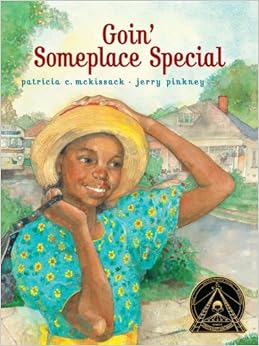
McKissack, P. (2001). Going' someplace special. New York: Atheneum Books.
Summary
'Tricia Ann is ready to take a big step and travel into town by herself. Her grandmother reminds her to remember that she is 'somebody' before 'Tricia Ann heads out the door. She is so excited to be traveling alone and is proud that she can get there on her own. Along the way 'Tricia Ann experiences multiple instances of segregation but also encounters encouraging friends who help her continue on her journey. After a morning of challenges, 'Tricia Ann reaches her "someplace special," the public library, where "all are welcome."
Impressions
I think this is a wonderful book that conveys what it was like to grow up in a segregated setting from a child's perspective. At the beginning of the book 'Tricia Ann seems like any typical young girl, wanting to do something that makes her feel independent and grown up. It's only after she sets off on her journey that we, the reader, realize that 'Tricia is living in the segregated south. I particularly enjoyed the people that she meets along the way. Every time 'Tricia Ann encounters something that makes her want to turn back and give up, she comes across someone who will encourage her and help her keep her head up. When she finally reaches the public library, we gain a sense of understanding about how wonderful it must have felt to find a place where everyone was treated equally, where no one was excluded simply because of the color of their skin. I especially loved that the "someplace special" was a public library.
Review
Tricia Ann's first solo trip out of her neighborhood reveals the segregation of 1950s' Nashville and the pride a young African-American girl takes in her heritage and her sense of self-worth. In an eye-opening journey, McKissack takes the child through an experience based upon her own personal history and the multiple indignities of the period. She experiences a city bus ride and segregated parks, restaurants, hotels, and theaters and travels toward "Someplace Special." In the end, readers see that 'Tricia Ann's destination is the integrated public library, a haven for all in a historical era of courage and change. Dialogue illustrates her confidence and intelligence as she bravely searches for truth in a city of Jim Crow signs. Pinkney re-creates the city in detailed pencil-and-watercolor art angled over full-page spreads, highlighting the young girl with vibrant color in each illustration. A thought-provoking story for group sharing and independent readers.
Review Reference
Elam, M. (2001, September). [Review of Goin' Someplace Special, by P.
McKissack]. School Library Journal. Retrieved from
http://libproxy.library.unt.edu:2071/ehost/detail/detail?vid=30&
sid=105c84c3-cba0-4214-858f-9e0a2fff46c6%40sessionmgr198&hid=112&
bdata=JnNjb3BlPXNpdGU%3d#db=lls&AN=5122224
Library Use
~This book would be a good title to use in a study of Civil Rights. Since it is written from a child's perspective, it would give students an understanding of what life would have been like for them if they lived in that time.
McKissack]. School Library Journal. Retrieved from
http://libproxy.library.unt.edu:2071/ehost/detail/detail?vid=30&
sid=105c84c3-cba0-4214-858f-9e0a2fff46c6%40sessionmgr198&hid=112&
bdata=JnNjb3BlPXNpdGU%3d#db=lls&AN=5122224
Library Use
~This book would be a good title to use in a study of Civil Rights. Since it is written from a child's perspective, it would give students an understanding of what life would have been like for them if they lived in that time.
Bibliographic Information
Rosoff, M. (2004). How I live now. New York: Random House, Inc.
Summary
Daisy arrives in England feeling sad and unwanted. She left her home in New York at the request of her stepmother, sent to live with an aunt and cousins she's never met. With a mother who died giving birth to her and a father she doesn't connect with, Daisy's expectations of her new life are pretty low. As she settles in to life in England, Daisy begins to appreciate her new family. Even though her aunt is very busy working with the government and facing the prospect of war, Daisy can still see how much she cares for her children and for Daisy as well. Daisy also has a growing affection for her all cousins, and she develops an especially strong attraction for her cousin Edmund.
After a few weeks, Aunt Penn departs on a work trip to Oslo, leaving Daisy and her cousins in charge of themselves for a few days. With Aunt Penn out of the house, Daisy and Edmund embark on a full-fledged affair. The cousins have only a short time to enjoy their freedom when war breaks out in London. At first their life in the countryside doesn't change very much. They live off food from the farm and supplies from the shop in the village. Everything changes when soldiers show up and commandeer the house, separating the boy cousins from Daisy and Piper. For a while the girls live with an army commander and his family, but Daisy has plans to escape and go back to the only place she's truly felt at home, back to Aunt Penn's house and to Edmund.
One night in the midst of a battle, Daisy and Piper put their plan in action. They run away with a few supplies and a compass that they hope will lead them home. Through days of wandering through the countryside, with little food and nothing to shelter them from the elements, Daisy finds a strength and courage inside herself that she never knew she had. Not long after they make it home, Daisy's father finds a way to bring her home to New York. Six years later, we find Daisy still longing for England. As soon as the war ends, she goes back, only to discover that Edmund is alive but very damaged from all that he's seen in the war. Because of her years of struggle, surviving the war, and dreaming of being reunited with Edmund, Daisy finally knows where she belongs, and she vows that she will do whatever it takes to help Edmund become whole again.
Impressions
I felt like I was on an emotional roller-coaster as I read this book. Daisy's struggles really strike a chord with the reader because she's going through things that all of us have felt at one time or another, even if our experiences aren't quite as dramatic as hers. I'm sure her longing to belong somewhere affected her judgement and emotions in regards to falling in love with Edmund. When she first realizes that she has feelings for him that are more than one would have for a cousin, she's worried and wants to keep those feelings a secret. But her inner struggle is not enough to keep her from him and his offers of acceptance and love. I liked how we see Daisy grow throughout the story, from someone who seemed so sad and broken when she first arrives in England, to someone who has the courage to wander across an unknown country to get back to those she loves. Even after years of separation and heartache, Daisy knows she has the strength to help Edmund find his way back to himself and her. This book is a true story of finding yourself among adversity and hardship.
Review
Daisy, 15, a troubled New York City teen with a distant father, a wicked (and pregnant) stepmother, and an eating disorder, is sent to England to stay on a rambling farm with her deceased mother's sister's family. It is made up of Aunt Penn "who always has Important Work To Do Related to the Peace Process" and her brood of children: Osbert, 16; 14-year-old twins Isaac and Edmond; and 9- year-old Piper. As the kids spend more and more time together, Daisy warms to them, beginning to tune in to a seemingly psychic bond that the siblings share. When Aunt Penn travels to Oslo, Daisy begins a sexual relationship with Edmond. At the same time, hostile forces invade England. Originally enjoying the freedom of a world that seems to have forgotten them, the cousins are inevitably separated, leaving Piper and Daisy to struggle across the countryside and rejoin the others. Daisy's voice is uneven, being at times teenage vapid, while elsewhere sporting a vocabulary rich with 50-cent words, phrases, and references. In addition, Rosoff barely scratches the surface of the material at hand. At times, this is both intentional and effective (the enemy is never named) but for the most part the dearth of explanation creates insurmountable questions around the basic mechanisms of the plot. There is no explanation of how a small force could take out all communications (including cell phones) and proceed to overrun and to control an entire country. Perhaps even stranger, the ramifications of psychic abilities and underage sexual relationships between first cousins is never addressed.
Review Reference
Davey, D. (2004, September). [Review of How I Live Now, by M. Rosoff]. School
Library Journal. Retrieved from http://libproxy.library.unt.edu:2071/ehost/
detai/detail?sid=af3f9db0-620d-42fc-830d-0ac468e78615%40sessionmgr
115&vid=16&hid=112&bdata=JnNjb3BlPXNpdGU%3d#db=lls&AN=
14408225
Library Use
~ This book would be a good read for a high school book club. Many teens deal with a sense of not belonging and feeling misunderstood. I think they would have strong connections with Daisy, and they might see some of her strength and resilience in themselves through the reading and discussion of this book.
Book Trailer by Melissa Leonard
Summary
Daisy arrives in England feeling sad and unwanted. She left her home in New York at the request of her stepmother, sent to live with an aunt and cousins she's never met. With a mother who died giving birth to her and a father she doesn't connect with, Daisy's expectations of her new life are pretty low. As she settles in to life in England, Daisy begins to appreciate her new family. Even though her aunt is very busy working with the government and facing the prospect of war, Daisy can still see how much she cares for her children and for Daisy as well. Daisy also has a growing affection for her all cousins, and she develops an especially strong attraction for her cousin Edmund.
After a few weeks, Aunt Penn departs on a work trip to Oslo, leaving Daisy and her cousins in charge of themselves for a few days. With Aunt Penn out of the house, Daisy and Edmund embark on a full-fledged affair. The cousins have only a short time to enjoy their freedom when war breaks out in London. At first their life in the countryside doesn't change very much. They live off food from the farm and supplies from the shop in the village. Everything changes when soldiers show up and commandeer the house, separating the boy cousins from Daisy and Piper. For a while the girls live with an army commander and his family, but Daisy has plans to escape and go back to the only place she's truly felt at home, back to Aunt Penn's house and to Edmund.
One night in the midst of a battle, Daisy and Piper put their plan in action. They run away with a few supplies and a compass that they hope will lead them home. Through days of wandering through the countryside, with little food and nothing to shelter them from the elements, Daisy finds a strength and courage inside herself that she never knew she had. Not long after they make it home, Daisy's father finds a way to bring her home to New York. Six years later, we find Daisy still longing for England. As soon as the war ends, she goes back, only to discover that Edmund is alive but very damaged from all that he's seen in the war. Because of her years of struggle, surviving the war, and dreaming of being reunited with Edmund, Daisy finally knows where she belongs, and she vows that she will do whatever it takes to help Edmund become whole again.
Impressions
I felt like I was on an emotional roller-coaster as I read this book. Daisy's struggles really strike a chord with the reader because she's going through things that all of us have felt at one time or another, even if our experiences aren't quite as dramatic as hers. I'm sure her longing to belong somewhere affected her judgement and emotions in regards to falling in love with Edmund. When she first realizes that she has feelings for him that are more than one would have for a cousin, she's worried and wants to keep those feelings a secret. But her inner struggle is not enough to keep her from him and his offers of acceptance and love. I liked how we see Daisy grow throughout the story, from someone who seemed so sad and broken when she first arrives in England, to someone who has the courage to wander across an unknown country to get back to those she loves. Even after years of separation and heartache, Daisy knows she has the strength to help Edmund find his way back to himself and her. This book is a true story of finding yourself among adversity and hardship.
Review
Daisy, 15, a troubled New York City teen with a distant father, a wicked (and pregnant) stepmother, and an eating disorder, is sent to England to stay on a rambling farm with her deceased mother's sister's family. It is made up of Aunt Penn "who always has Important Work To Do Related to the Peace Process" and her brood of children: Osbert, 16; 14-year-old twins Isaac and Edmond; and 9- year-old Piper. As the kids spend more and more time together, Daisy warms to them, beginning to tune in to a seemingly psychic bond that the siblings share. When Aunt Penn travels to Oslo, Daisy begins a sexual relationship with Edmond. At the same time, hostile forces invade England. Originally enjoying the freedom of a world that seems to have forgotten them, the cousins are inevitably separated, leaving Piper and Daisy to struggle across the countryside and rejoin the others. Daisy's voice is uneven, being at times teenage vapid, while elsewhere sporting a vocabulary rich with 50-cent words, phrases, and references. In addition, Rosoff barely scratches the surface of the material at hand. At times, this is both intentional and effective (the enemy is never named) but for the most part the dearth of explanation creates insurmountable questions around the basic mechanisms of the plot. There is no explanation of how a small force could take out all communications (including cell phones) and proceed to overrun and to control an entire country. Perhaps even stranger, the ramifications of psychic abilities and underage sexual relationships between first cousins is never addressed.
Review Reference
Davey, D. (2004, September). [Review of How I Live Now, by M. Rosoff]. School
Library Journal. Retrieved from http://libproxy.library.unt.edu:2071/ehost/
detai/detail?sid=af3f9db0-620d-42fc-830d-0ac468e78615%40sessionmgr
115&vid=16&hid=112&bdata=JnNjb3BlPXNpdGU%3d#db=lls&AN=
14408225
Library Use
~ This book would be a good read for a high school book club. Many teens deal with a sense of not belonging and feeling misunderstood. I think they would have strong connections with Daisy, and they might see some of her strength and resilience in themselves through the reading and discussion of this book.
Book Trailer by Melissa Leonard
Subscribe to:
Comments (Atom)